
Uzbek Entrepreneur Goes from Selling Carpets to Building an AI Startup for the US Furniture and Home Goods Market



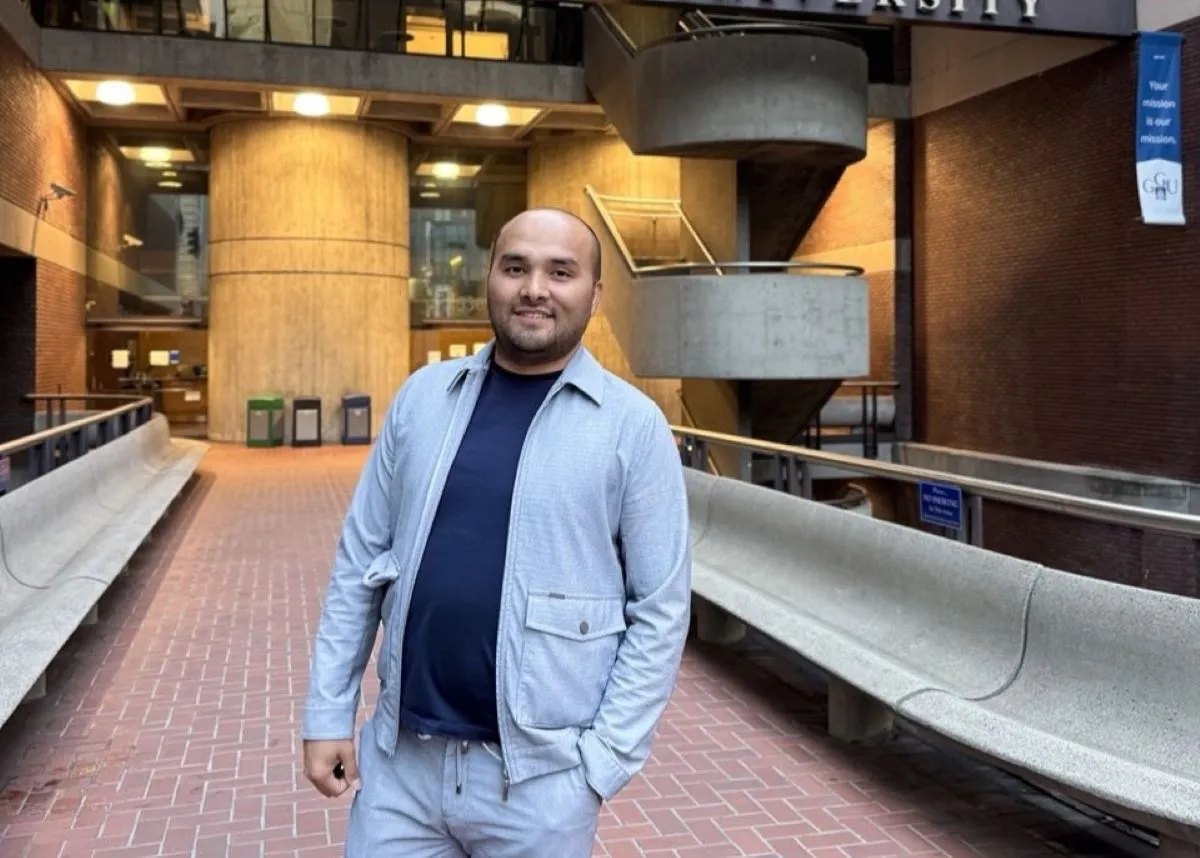
Хикматилло Умарходжиев
Hikmatillo Umarhojiyev is 31 years old. He grew up in a family of carpet makers in Andijan, sold carpets, and built up a retail business. Later, he moved to the US and launched Findecor, a startup that helped shoppers visualize furniture and other home decor items in their own rooms. In 2026, Hikmatillo switched gears with a new team and began working on Arbuz, an AI-powered service for furniture retailers that is already being tested by 10 companies in the US.
For the Astana Hub and Digital Business project “100 Startups of Central Eurasia,” Hikmatillo spoke about why the startup’s first model didn’t work, where he found his first B2B clients in the US, and what he gained from taking part in the Silicon Valley Residency program.

“I learned carpet weaving in my grandfather’s workshop from an early age”
– Hikmatillo, tell us about yourself. What did you do before moving to the US?
– I was born in Andijan in 1995. From an early age, I learned carpet weaving in my grandfather’s workshop: I worked at the loom, learned about different materials, and assessed knot density and the quality of the patterns. Later, I joined our family carpet business, Mamadaliev Islombek gilamlari, where I worked as an apprentice for six years.

In 2013, I enrolled at the University of Sunderland in the UK to study Accounting and Finance, and graduated in 2017. At the same time, in 2016, I founded a handmade carpet weaving atelier in two cities in Uzbekistan, Margilan and Asaka. We produced more than 500 pieces, some of which were supplied to Europe and the US. I also developed a carpet retail dealer network. Between 2020 and 2023, it grew from one store to four, sales increased by around 250%, and our customer base exceeded 2,600 households.

Over the years, I learned the carpet business from different angles. I worked on product selection, design, production, retail sales, operations, and customer communication.
– Why did you decide to move to the US and launch a tech startup?
– I came to the US on a student visa to pursue an MBA at Golden Gate University. I wanted to understand how technology could transform the home goods market, which I already knew well.
So I got into startups not as a programmer, but as an entrepreneur who understands the customer, the product, and the sales process from the inside.

– How did you get the idea for your first project?
– For years, I kept hearing the same questions from customers: “Will this fit my room?” “Is this the right size?” “Do the colors go together?” “What should I place next to it?” There’s always a lot of hesitation when people are making a purchase. I started thinking about how to remove that uncertainty, and came to the idea that we needed to use the customer’s actual room. That’s how the idea for Findecor came about.
“A retailer got a tool that helped them sell”
– What was the startup?
– I launched Findecor in March 2025 as a B2C service for everyday shoppers. Users would take a photo of their room, and the system would add furniture and other interior items that could work in the space.
Later, I conducted 30 in-depth interviews with store owners. Their first reaction was emotional: almost everyone liked seeing a rug or sofa visualized in a real room. But then retailers started asking, “Are these my products? Do I have them in stock?”
We realized that a nice-looking image wasn’t enough for stores. They needed to show customers products they could actually buy. So we started connecting retailers’ real catalogs to the service, including their product ranges, prices, and stock levels. That’s how we moved from B2C to B2B.

As we tested the product, spoke with retailers, and got a better sense of what the technology could do, the way we saw the problem changed. Instead of asking, “How can we show people more products?”, we started asking, “How can we help them see what works in their space and feel confident about making a purchase?”
I gradually put Findecor on hold, and in February 2026, I started working on a new project, this time based on augmented reality. I called it Arbuz.
“We guide customers from a single item to a full-room set”
– What’s the idea behind the new project?
– It’s an AI system for furniture retailers that helps customers build an interior around a product they’ve already chosen. Imagine a shopper likes a sofa on a retailer’s website. With Arbuz, they can place that sofa in their room using AR. The system then suggests matching products from the retailer’s catalog, such as a rug, coffee table, armchair, or lamp. The customer can see how the whole room comes together and decide what to add to their cart.

– What makes Arbuz different from other solutions on the US market?
– We’re usually compared with two types of solutions. 3D rendering services create high-quality visuals, but they sit separately from the sales process. AR tools that let you try out a single product show how an item looks in a room, but they don’t answer the question of what to place next to it. We work with the retailer’s actual catalog and guide the customer from one product to a full-room set.
Arbuz is integrated into a furniture retailer’s website. A customer might choose a sofa, for example, place it in their room using AR, and the service then suggests other products from the same store to go with it.
– What technologies does Arbuz use? Do you use your own AI models or third-party solutions?
– We develop Arbuz’s core technology ourselves. These are systems that analyze a room and match products from a retailer’s catalog that work well together. We run modern AI models on our own infrastructure, which lets us control the system’s quality and speed, as well as the security of customer data.

– Why should retailers use Arbuz?
– We expect Arbuz to improve conversion rates, average order value, the number of items per order, and customer confidence when making a purchase. If someone can see a sofa in their own room and immediately understand what goes well with it, there’s less uncertainty, and they may choose several items instead of just one.
We first record the retailer’s baseline metrics, then measure what changes after Arbuz is integrated. We look at engagement on product pages, conversion rates, average order value, the number of items per order, and, where the data is available, returns.
Our goal is very practical. We want retailers to be able to look at their own numbers and say, “Arbuz helped us sell more.” If we can deliver that result consistently, then we’ve created more than just an impressive AI feature. We’ve built a tool that generates profit.

“We currently have 10 corporate pilots at different stages”
– Tell us how you find clients.
– I personally reach out to company owners and heads of sales and marketing. At an early stage, you need to speak to customers yourself. My team and I also took part in High Point Market, the world’s largest furniture and home furnishings trade show in the US.
The hardest part was entering a new market where no one knew me. Just telling retailers about the product wasn’t enough. They wanted to see whether the service really worked, whether it could be integrated with their existing systems, and whether it could deliver measurable results.
That’s when we started offering pilot projects, so companies could test Arbuz using their own catalogs.

– How many stores are currently testing Arbuz?
– We currently have 10 corporate pilots at different stages. They’re furniture and home goods companies, mostly independent retailers and regional chains with both showrooms and online stores.
Our focus is on mid-sized retailers. They already have product catalogs, traffic, and sales, but they don’t have the engineering teams to build this kind of technology in-house.
– How do retailers pay for your service, and how long does it take to launch a pilot?
– A pilot almost always starts with a short free or discounted period. After that, we switch to a monthly subscription. The price depends on the size of the catalog and the number of sales locations.
On average, it takes around 1.5 to 3 months to go from the first contact to a pilot. Connecting the catalog itself usually takes 5 to 10 business days.

“We’ll raise investment when we see consistent results”
– How did you fund the development of Findecor and Arbuz?
– At first, I invested my own money from the carpet and retail businesses. At an early stage, Findecor also received angel funding through a SAFE.
We’ll raise investment for Arbuz once we see consistent results and understand that additional capital can help us scale a model that’s already working.
– And who’s building Arbuz with you today?
– Abdulaziz Alimov and John Azimov. I met them at Silkroad Innovation Hub in Silicon Valley.
I’m the co-founder and CEO, responsible for the overall vision, clients, sales, partnerships, fundraising, and business strategy. Abdulaziz is the CTO. He has more than 10 years of engineering experience and, before joining the startup, worked on the early engineering teams at US unicorns Jasper and Olive. He created ChatVLM, an AI platform that plays a key role in building Arbuz. It has its own intelligent architecture for routing requests between models and gives us full control over how commercial data is processed.
John handles all legal matters. He has 20 years of experience in this field.

We also have three engineers and a marketer working from our Mountain View office, while another four developers are based in Tashkent.
– You met your co-founders through Silkroad Innovation Hub. Which programs or events was that through?
– In 2025, we took part in the AlchemistX & Silicon Valley Residency Program with Findecor. It was run by Astana Hub, Silkroad Innovation Hub, Alchemist Accelerator, and IT Park Uzbekistan. For us, it was a chance to understand the US market better. I especially remember the sessions on B2B sales and working with investors, the pitch reviews, and the direct introductions to retailers and entrepreneurs.
It was during the program that we shifted to B2B, focusing on carpet stores and retailers, and signed our first five clients in Silicon Valley.

– Where do you see the company in five years?
– I want Arbuz to become one of the main tools for selling furniture and home goods online. Our goal is to build a sustainable global B2B company with customers and measurable value.
Buying furniture online is still surprisingly flat. You see a product photo and have to imagine for yourself how it will look in your space and what to put next to it. We hope to change that with our product.