
A Young Woman from Uzbekistan Invested $67,000 to Build a Leadership Development Platform



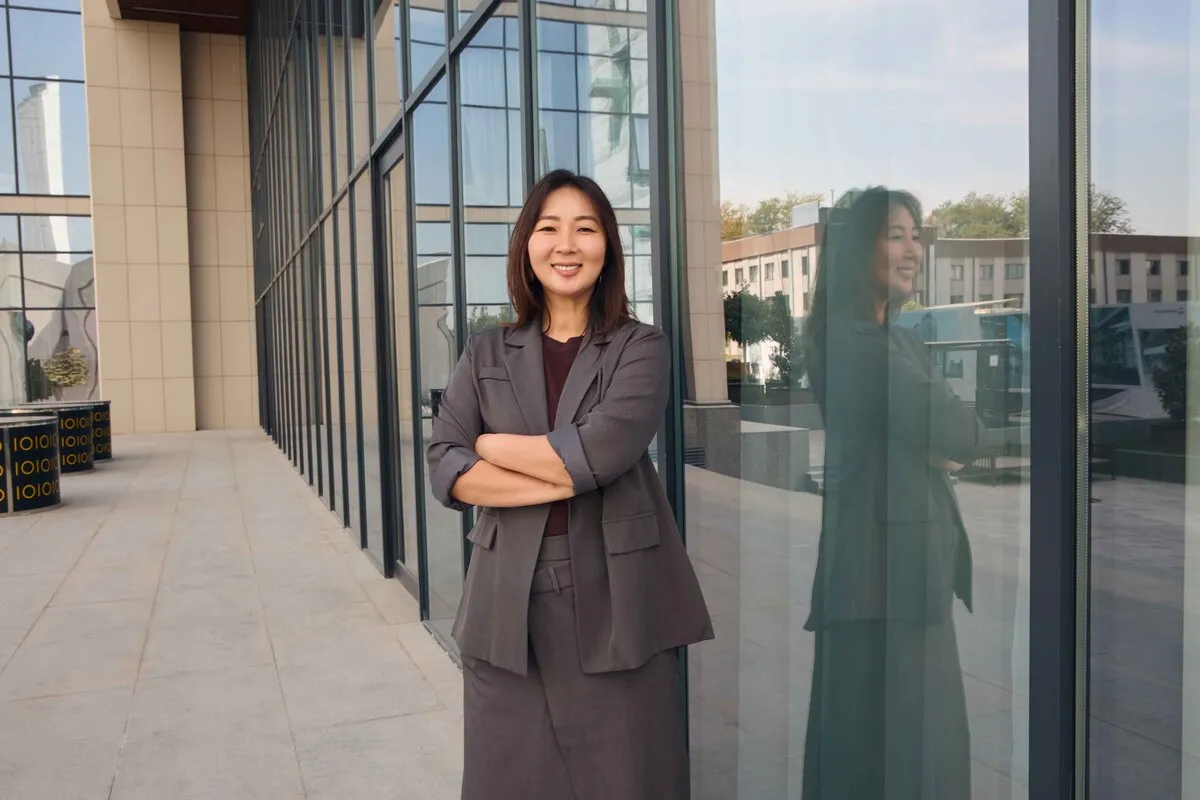
Nadezhda Ni’s startup journey began in 2019 with Growy, a B2C service that gave users a life balance wheel assessing different areas of their lives, along with recommendations on how to improve them. She later worked on a B2B delegation solution, took part in several accelerator programmes, and conducted hundreds of customer development interviews. After completing the AlchemistX programme, Nadezhda founded a company in the US and launched a new product, ttune.ai. It is a tool that analyses online calls and gives managers feedback on how well they demonstrate four key leadership qualities. Over the past nine months, Nadezhda has invested $67,000 in the product.
For the Astana Hub and Digital Business project “100 Startup Stories from Central Eurasia”, Nadezhda spoke about what was wrong with the early versions of the project, how the idea for ttune.ai came about, and why she is deliberately in no rush to grow the number of customers.
“We wanted to help people become happier”
– Nadezhda, what were you doing before launching your startup?

– I studied philology and graduated from the Korean Language and Literature Department at Nizami Tashkent State Pedagogical University. Back in my first year, I told everyone I wanted to become the president’s interpreter. In the end, I actually came pretty close to that dream. I worked as a Korean interpreter at international meetings with government representatives. I interpreted for officials from South Korea and Uzbekistan, and also for diplomat Ban Ki-moon when he was serving as Secretary-General of the United Nations.

Later, I decided I wanted to start my own business. It turned out to be quite a challenge because I had no relevant experience at the time. Not long after that, my partners and I opened Robokidz, the first robotics school in Uzbekistan. We exited the business in 2020. After that, I went on to start several other companies. One of them was Growy.
– What was the first version of the project like?
– At first, I built Growy together with former colleagues and friends. We wanted to help people become happier. On the platform, users filled out a questionnaire and received their own version of a life balance wheel. They could see which areas of their life needed more attention and explore tools that could help improve them.
We launched five months before the COVID-19 pandemic. When lockdowns began, our sales increased fivefold. At one point, the platform had 5,000 users across 16 countries.
But we soon realized that the product had a very short LTV (lifetime value, meaning the total profit or revenue a customer brings to a company over the entire time they use its product or service – Digital Business). People would use the platform for two or three months and then stop coming back.

– How did you tackle that problem?
– We shifted our focus to B2B and built a delegation tool based on coaching principles. A manager would assign a task to an employee, and our platform would help them break it down into steps and work out for themselves how best to approach it. This helped reduce procrastination.
But this product eventually ran its course too. AI was developing rapidly, and it became clear that the new AI tools could handle this task more effectively than the solution we were using.
At the same time, my partners gradually stepped away from day-to-day operations. I, on the other hand, became increasingly interested in the startup world and decided to give the project one more shot.
– How did you go about it?
– I went through several accelerator programmes. I was selected for FoundHER, a programme run by venture capital firm Plug and Play for female founders from Central Asia. I made it into the top five participants and travelled to Silicon Valley. Later, I joined Plug and Play Uzbekistan, which helped me shift from an entrepreneurial mindset to a startup mindset.
When I came back, I started developing Growy not just as a business, but as a startup. I began testing hypotheses, interviewing potential customers, and making changes to the product much faster.

I was selected for AlchemistX, a US accelerator programme launched by Astana Hub together with IT Park Uzbekistan, Silkroad Innovation Hub, and the US-based Alchemist Accelerator. I didn’t expect the programme to be so personalized. Each participant had their own mentor, and we met once a week to discuss how the project was progressing. The programme really helped me understand how the US market works and build valuable connections.
During AlchemistX, I conducted a series of customer development interviews. That led to a completely new product, ttune.ai. I also registered a company in the US.
“Employees rarely leave companies. More often, they leave because of poor leadership”
– What does ttune.ai offer today?
– ttune.ai is a leadership development platform that analyzes conversations during online calls and gives managers feedback on how well developed their leadership skills are. There’s no need to install a separate app. The assistant simply joins your Zoom call.
After the call, the manager receives a comprehensive assessment of their leadership competencies across four areas: presence, trust, direction, and initiative. For example, the system shows how much time the manager spends talking versus listening, whether they create a trusting atmosphere during the conversation, and how proactive they are.
Before the next conversation with the same employee, the manager receives recommendations, such as asking more open-ended questions or avoiding interruptions. They can also see an overall leadership index based on calls with all of their direct reports. This makes it possible to spot a decline in the score early on and take appropriate action.

– Why is a service like this relevant today?
– It comes down to employee turnover and burnout. In most cases, people don’t leave companies so much as they leave poor leadership. At the same time, managers don’t always find it easy to get honest feedback. Employees may worry about damaging their relationship with their manager, avoid confrontation, or simply feel uncomfortable pointing out their weaknesses directly. ttune.ai helps managers look at their own behavior from the outside and identify problem areas based on real conversations. HR teams and senior managers can also see anonymized analytics across the company, such as how leadership indicators, soft skills, and signs of burnout are changing across teams.
– Who is your typical customer?
– The product is most useful for companies with an established corporate culture and well-defined processes. Typically, these are businesses with 100 or more employees and several layers of management. It’s also important that at least 70% of meetings take place online.
– Where did you find your first customers?
– My network and personal recommendations really helped. I have quite a few friends who are business owners, and a couple of years ago I was president of Koryoin, the Korean Entrepreneurs Club of Uzbekistan. At first, I let a number of companies I knew test the pilot version, collected their feedback, and only started working with them commercially a few months later.
– Which markets are you most interested in?
– We decided not to limit ourselves to a single region. At first, we were looking at the US market. But while I was doing AlchemistX, I realized that focusing on the US would mean moving there. I wasn’t ready for that yet, so I wanted to see whether the problem ttune.ai solves was just as relevant in other countries.

I joined the Khan Tengri Innovation Hub accelerator program in Shanghai, explored the Chinese market, and then went on a business trip across Southeast Asia. In the end, I realized that the quality of management is an issue across different markets. In the US, for example, management turnover is especially costly for companies. According to Gallup, replacing a manager or leader can cost around twice their annual salary.
In other countries, the costs may be lower, but the problem itself is still there. That’s why we’re trying to build a product that can be used in any market.
– How many customers does ttune.ai have now?
– At the moment, we have just three paying customers: a logistics company from South Korea, an international retail company, and a university in Uzbekistan.
I’m deliberately not taking on more contracts until I see that these first three customers are getting the results they need.
“I recently secured my first angel investment”
– What is your business model?
– We work on a subscription model, with pricing based on the number of calls and the number of people using the service.
– Are you making money yet?
– Our latest MRR was $5,600. But I reinvest everything that’s left after our main expenses back into the project.

– How have you funded the startup so far?
– Over the nine months that ttune.ai has been around, I’ve invested $67,000 in the project. I also reinvested all the profit we had made before that. Recently, though, I secured my first angel investment of $15,000. We’ll use the money to expand the team.
– Who else is working on ttune.ai with you?
– The team is still small, just three people. We’re based in Uzbekistan.
“Usually, startups don’t survive this many pivots”
– Over the years, you’ve launched different businesses, changed Growy several times, and gone through a number of accelerator programs. What have you ultimately learned about how to build a startup?
– I’ve become convinced that a project should be making money from the very beginning. I’m not prepared to build a product on investor money in the hope that one day it will take off and the investment will pay off. For me, it’s important to understand how the startup solves a real problem and how it will make money.
I realized that running your own business makes you incredibly resilient. Most startups don’t survive that many pivots. Of course, financially it was tough to support both myself and the team, but my whole life has taught me that success often comes on the eleventh push-up out of ten. I’m used to going the extra mile. I’m a third-generation Korean who speaks Russian and lives in Uzbekistan. In other words, I’m not Korean enough for Korea, not Uzbek enough for Uzbekistan, not enough of a man for business, and not enough of a woman in the traditional sense of the word. So I understood very early on that I needed to work 30% harder than everyone else, and for me, that feels completely normal.
I’ve made a lot of mistakes along the way. For example, I could get too attached to an idea and spend far too much time on a hypothesis that simply wasn’t working. Instead of dropping it at the right moment, I would convince myself that the problem was the audience. Startups are always about speed, and sometimes I just wasn’t moving fast enough. But I’m still learning.

– What are your goals for the next year?
– The main goal is to successfully complete a major pilot and speed up sales.
We also plan to train the system to analyze tone of voice and facial expressions so it can provide better recommendations. One thing I know for sure: this is far from the final version of our product.