
Kazakh Team Finds a New Way to Digitize Cities, Attracting Interest Abroad




Дана Шукирбаева, сооснователь Qala AI
Dana Shukirbayeva was born in Astana, graduated from Nazarbayev Intellectual School with a focus on physics and mathematics, and then moved to Moscow. She went on to study environmental science at Moscow State University before earning a master’s degree in urban spatial development management from the Higher School of Economics. Her career has taken her in a few very different directions. She worked at the Moscow Department of Transport, produced cultural special projects for the St. Petersburg International Economic Forum, and later helped export IT solutions to Saudi Arabia.
In 2021, Dana returned to Kazakhstan and set up her own consulting firm. Later, she teamed up with entrepreneur Madi Saken, combining her analysts with his IT specialists. Together, they launched Qala AI, an UrbanTech startup building AI-powered platforms that help businesses and city authorities make decisions based on big data.
For the joint Digital Business and Astana Hub project “100 Startup Stories from Central Eurasia”, Dana spoke about why the system analyzes 70 aspects of the urban environment, how data can help businesses avoid choosing the wrong location, the challenges B2G startups face in Kazakhstan, and why Almaty urgently needs to draw on Japan’s experience in earthquake resilience.
“We need to move away from the ‘facilities manager’ mindset in how cities are run”
— How did Qala AI get started? What was the problem you wanted to solve?
— After the pandemic, I kept working remotely from Astana for a Moscow-based IT company. At some point, I just got tired of it, quit, and started my own consulting firm. We focused on ESG consulting because, during the pandemic, I’d taken a course at Berkeley and earned a GRI certification. We prepared non-financial reports and carried out urban and sociological research for developers and construction companies. The real estate and development market here turned out to be fairly small, and there weren’t many specialists with a relevant professional background, so our expertise was in very high demand.
At the same time, I was invited to teach geographic information systems, or GIS, to urban planning students at AlmaU. The students found it pretty dull to just work with maps, so I thought it would be much more interesting to let them get hands-on with real data. During my master’s, I’d had an amazing experience working with telecom data, so I decided to look for something similar in Kazakhstan. The university connected me with Almaty’s Digitalization Department, which was headed at the time by Bayan Konirbayev. He then introduced me to my future partner, Madi Saken.

Madi’s IT company had already been working with telecom operators for years. They cleaned their data, built data lakes, and structured information for city services. During COVID, for example, the city needed to track places where large numbers of people were gathering and identify subscribers’ work and home areas.
They were mainly focused on the technical side, but as an urban planner, I could see there was a lot more we could do with the data. So I said to Madi, why don’t we work together? I had a team of experts in urban economics, environmental issues, and urban planning, and he had a really strong IT team. They just needed someone to point them in the right direction. In the autumn of 2023, we decided to take a chance, bring these two very different teams together, and start Qala AI.

We wanted to use big data to assess the urban environment as a whole and offer something like that to the Almaty city administration. Almaty is a very complex city geographically, with a lot of constraints and some serious risks, from the divide between wealthier and poorer neighborhoods to environmental issues, transport, and earthquakes. What we were proposing was a data-driven approach to managing the city. We also pushed the idea of resilience, which goes beyond sustainable development and is really about being prepared for risks. So we built a platform that helps plan the city’s development with all of these factors in mind.
— Who funded the startup in the beginning?
— In that sense, Qala AI isn’t really a typical startup because we didn’t go out looking for investment. Madi and I were bringing two existing teams together, so we already had clients and established relationships. For the first six months or so, we funded the startup ourselves. Then, while we were developing the product idea, we started taking on geomarketing projects for different retailers, developers, and construction companies. Those projects helped us keep the team going while we worked towards new contracts.

— How did Astana Hub help Qala AI grow?
— Qala AI joined Astana Hub as a resident when we launched. The biggest thing Astana Hub gives us is access to people and connections. We’re often invited to meetings with international delegations, and they also create opportunities for us to speak directly with representatives of Kazakhstan’s public sector. For complex infrastructure-focused B2G solutions like ours, that kind of access is absolutely essential.
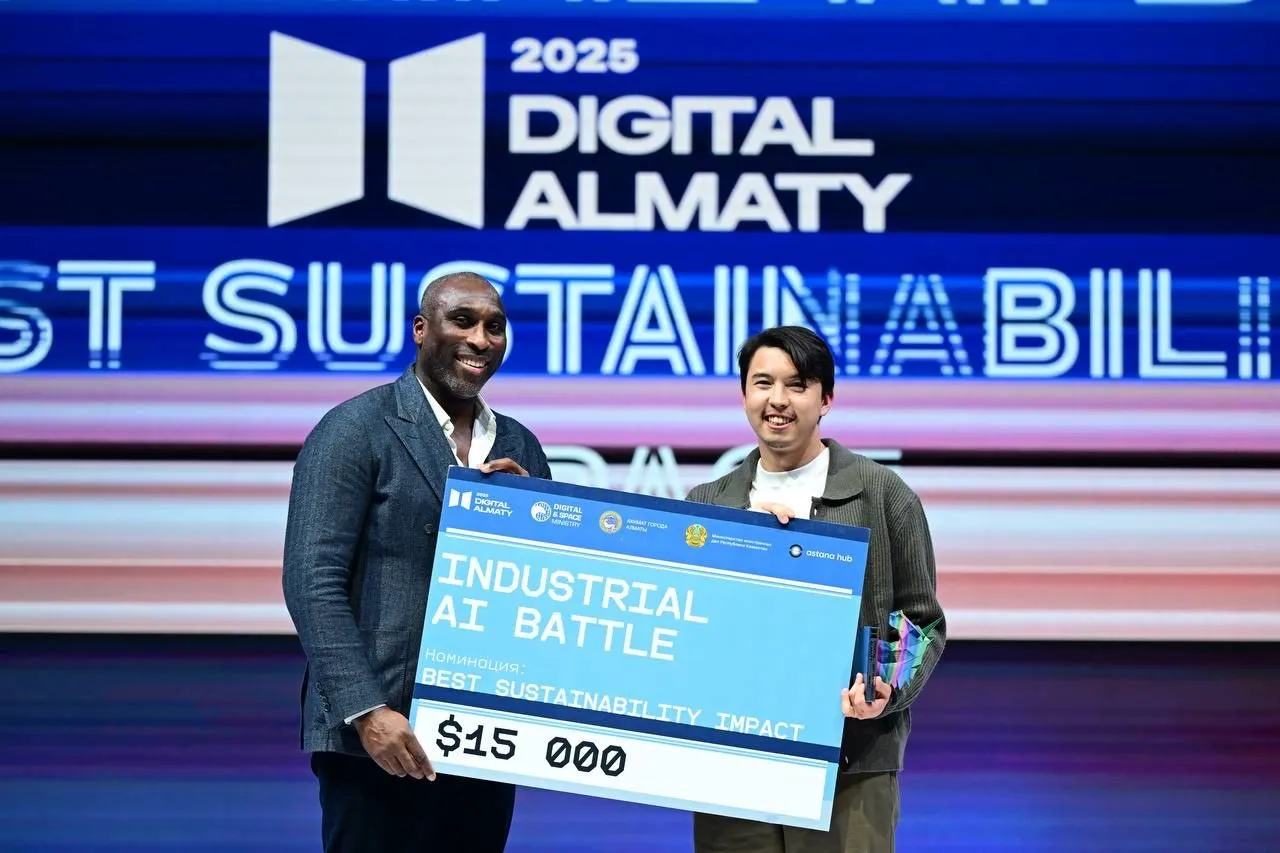
In 2025, with support from the Hub, we also won the Industrial Artificial Intelligence (AI) Battle startup competition at the Digital Almaty forum and received $15,000. At the same event, we were awarded the Yandex Qazaqstan Startup Spotlight Award.
“You’re an IT company, just scrape the data”
— Geoanalytics relies on huge amounts of information. Where does all that data come from, and how do you collect it?
— We pay for our data, and that’s something we feel quite strongly about. It’s also something we often have to explain to clients. In Kazakhstan, people are used to watching films for free, and there’s a similar reluctance to pay for information. Even large clients sometimes ask us, “Why pay for it? You’re an IT company, just scrape the data.” But I’m trying to encourage a different mindset around data. Good-quality information has value, and you need to pay for it so that the provider is accountable for what they supply and can stand behind its accuracy and validity.

First, we buy raw data from telecom operators and fiscal data operators. That gives us a picture of actual population density, how people move around, and where economic activity is happening.
Second, we partner with 2GIS and Yandex and buy detailed data from them on points of interest, user activity, and travel routes.
Third, we purchase satellite imagery, which we use to calculate environmental indicators such as NDVI, the normalized difference vegetation index. We also integrate with open government databases, including Smart Data Ukimet, while following all the required information security procedures through the Ministry of Digital Development, Innovation and Aerospace Industry.

— Your website clearly separates the products into B2G, Resilient City, and B2B, Resilient Business. What’s the main difference between the two in terms of how they’re built and what they’re designed to do?
— Resilient City Platform is designed for city administrations and brings together more than 70 indicators related to infrastructure development. The analytics can be viewed at different scales, from an individual courtyard all the way up to an entire district.
The indicators are grouped into five sub-indices: environment, the built environment and housing, social infrastructure, commercial activity, and transport accessibility.
For someone working at the city administration, it’s not just a map. The platform has a built-in “what-if” analysis feature, so users can model different scenarios. Say the city needs to build eight new schools. The platform doesn’t simply show empty spaces on the master plan. It can analyze whether moving a school 300 meters to the left, for example, would do a better job of serving a densely populated neighbourhood.

It also gives each department specific recommendations based on its KPIs, whether that means where to plant trees to tackle urban heat islands or where public transport routes need to be strengthened. There’s also an AI assistant. If an official urgently needs to prepare a briefing note, they can simply type something like, “Show me the areas with the fewest trees,” and the system will generate an analytical report.
Resilient Business Platform solves a different problem: helping businesses find the most profitable location for a new outlet. It calculates the commercial potential of a specific address and gives you a detailed demographic profile of the area, including age, income, and interests. You simply enter an address and get a full analysis, along with AI-generated recommendations.
— Selling to the public sector usually means long sales cycles. What kind of bureaucracy do you have to deal with when working with city administrations?
— In venture capital, people often say that a B2G startup is a red flag. Investors are put off by the long sales cycles because government systems move slowly. You can spend six months building a relationship with a city administration and proving that the platform works, and then the leadership changes, the mayor gets moved to another position, and you have to start building those relationships all over again.
But local innovative solutions have to come from somewhere. We can’t keep buying everything from abroad or relying only on huge quasi-government companies. If you’re solving a real problem for a city, you’re directly affecting people’s lives.

Luckily, we’ve been developing the B2B side at the same time. It gives the company a steady source of income and helps us keep the team going while all the lengthy government approvals are still moving through the system.
— How does the product make money, and has it reached the point where it pays for itself?
— We’ve reached operational break-even. On the B2B side, we use a mix of package-based pricing and subscriptions. Large chains, such as retailers or marketplaces, usually take out an annual subscription so they can analyze dozens of locations without any limits. Smaller businesses tend to buy starter packages covering three to five locations, with detailed analytics for each one.
In the first half of 2026 alone, our B2B revenue was more than $100,000.
In the public sector, Almaty is still our main client. We’ve also run pilot projects in Petropavlovsk, Osh, Namangan, Dushanbe, and Abu Dhabi. We don’t disclose the exact value of individual contracts, but the total value of the city projects we’ve completed has already passed $1 million.
“We’re not trying to predict earthquakes. We’re looking at how prepared a city is when one happens”
— In spring 2025, you signed a memorandum with Japanese company Nippon Koei on seismic analysis for Almaty. Where did the idea start, and what does the pilot involve?
— It started as a personal initiative. Talking about urban development in Almaty and ignoring seismic risk is, frankly, incredibly short-sighted. For a long time, I kept going to the emergency services, city administrations, and ministries with the idea of digitizing this whole process.

Then I started looking into what had actually been done in this area before. It turned out that the last major study of Almaty’s seismic safety was completed back in 2009, and it was carried out by a Japanese team with funding from the Japanese government.
It took a lot of time to get through to Nippon Koei and build enough trust with them. It’s a long-established engineering company, founded back in 1946. Eventually, I got the chance to go to Tokyo and spend a week in their office. I even managed to track down the very same specialists who had lived in Almaty’s Orbita neighbourhood in the 2000s and carried out that original study.
I came back to Kazakhstan with the memorandum already signed and started pitching the project to the government all over again. In the end, the larger initiative got support from the United Nations Development Programme, which has a dedicated area of work focused on natural disasters.
— How will the platform assess how well Almaty can withstand an earthquake?
— No one in the world can predict earthquakes. If that were possible, the Japanese would have figured it out a long time ago. What we can assess is how prepared a city is for the impact.
It’s a large-scale, three-year project built around four main areas.
The first part is building a digital model of the city’s entire infrastructure. We’re collecting a huge amount of data on every building, including when it was built, what materials were used, and how much wear and tear it has. The system will be able to show what could happen in an earthquake of, say, magnitude five or seven. Would a particular building withstand it? How many homes could collapse?

The second part follows directly from that: deciding where investment is needed most. In other words, where the city should urgently direct funding to strengthen critical infrastructure before a disaster happens.
The third area is absolutely critical: developing clear rules for the road network. In a major earthquake, there need to be streets that civilian vehicles are strictly banned from using. Those routes have to stay completely clear so that police, fire crews, and ambulances can reach outlying areas and collapsed buildings without getting stuck in traffic.
What happened during the recent tremors in Almaty showed exactly why this matters. People rushed to their cars and tried to drive somewhere, creating complete gridlock. In a real disaster, that would mean emergency services simply wouldn’t be able to reach people in time. People need to be able to walk to evacuation points and know that help will come to them.
The fourth area is mapping all evacuation points and putting clear action plans in place for every government agency in the event of a “red alert.” The floods showed just how serious this problem is. Many local authorities simply don’t know what they’re supposed to do because there are no clear procedures in place.
We also need to check the condition of the evacuation points. If a disaster happens, we need to know whether people will be able to stay in the places that have been designated for them. I’ve visited eight earthquake museums around the world, and I know that after some natural disasters, people weren’t just left without a roof over their heads. They were literally sleeping on the bare ground in winter. A city has to be prepared for the worst-case scenarios.

Ultimately, we want to digitize Almaty in a way that brings all of this analysis onto one screen, so the data is easy to work with and it’s immediately clear which areas need urgent attention.
— Where do you want Qala AI to be in five years?
— I really hope that in five years the seismic project will be fully in place and Almaty will be ready for whatever happens.
Qala AI will definitely stay focused on urban economics, geoanalytics, and data. But strategically, we’ll be putting more emphasis on B2B: developing new commercial products, scaling the business, and attracting investment.
We’ll still be working on B2G projects as well. Uzbekistan is particularly interesting to us in that respect. Tashkent has a lot in common with Almaty: old neighbourhoods are being demolished, new residential developments are going up, and population density is rising quickly.
Most importantly, people there still remember the devastating 1966 earthquake. There’s a real concern that something similar could happen again, so the need for better safety measures and thoughtful geospatial planning is much more strongly felt there than it is in Kazakhstan.