
Kazakhstani Team Builds AI Mental Health Platform Used by 1M+ Students



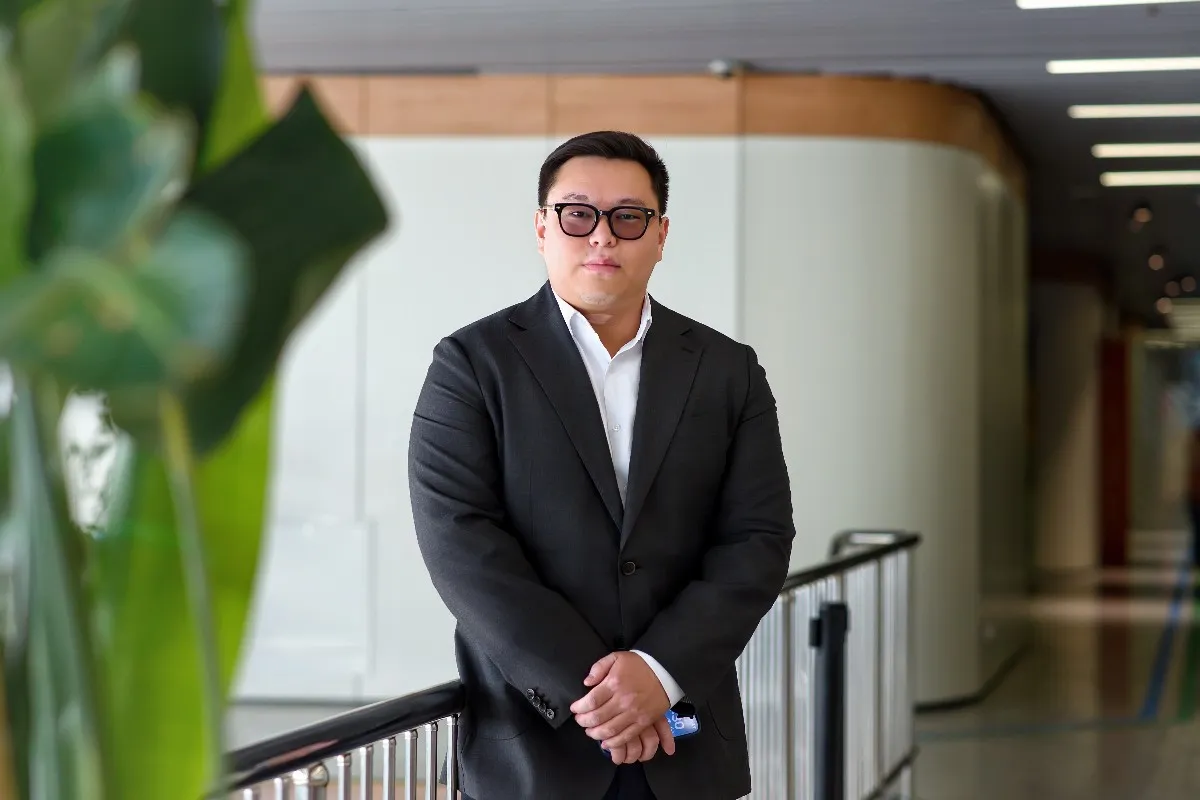
Акжол Замбаев
Akzhol Zambayev is originally from Taraz. He graduated from Nazarbayev University and first saw himself going into science and becoming a biologist. But while still at university, he discovered entrepreneurship and began launching education projects.
In 2023, Akzhol teamed up with programmer and KAIST graduate Bolat Ashim to launch WeGlobal AI. The startup is building a platform with AI tools for psychologists and career counselors. Today, the service is already used in 2,000 schools and reaches more than 1 million students.
For the joint Digital Business and Astana Hub project, 100 Startup Stories from Central Eurasia, Akzhol shared how the company managed to bring its IT product into public schools, why he traveled more than 20,000 kilometers across southern Kazakhstan, and why WeGlobal AI is now targeting the US and UK markets. We also talked about the company’s business model and what allows the service to scale nationwide.
«It can take a school psychologist up to six weeks to complete a single assessment»
– Tell us about what you were doing before launching WeGlobal AI?
– At first, I saw my future in science: I enrolled at Nazarbayev University to study Biological Sciences and planned to grow in research. But while I was still a student, I started getting interested in entrepreneurship.
The turning point was volunteering at the Astana Economic Forum. That was the first time I saw from the inside how major investors and entrepreneurs negotiate and make strategic decisions.
That atmosphere really influenced me and pushed me to study business, finance, and the principles behind building sustainable projects more deeply. In my fourth year, I launched my first EdTech startup, an educational platform focused on natural and exact sciences. Our clients were schools and individuals. In 2020, our team managed to sell the product. After that, I became a partner in another education startup that helped students apply to universities abroad. Three years later, I decided to leave the project.
– How did the idea for your next startup come about?
– My co-founder and CTO, Bolat Ashim, and I started brainstorming and looking for real, systemic problems in education that AI could help solve. Back then, good career guidance was mostly something you could get only at private schools. We wanted to change that and make it available to every student in Kazakhstan. That’s how WeGlobal AI came about, a SaaS platform for schools with career guidance tools.

Bolat Ashim
During the pilot launch in schools in Astana, we realized the solution was also in demand among psychologists, since in many schools they are the ones responsible for career guidance.
– What problem does the product solve for psychologists?
– One specialist often works with hundreds of children at the same time. A big part of the job is still done manually: psychologists print out questionnaires, collect responses, transfer the data into Excel, and analyze the results themselves to understand which students may need extra attention and support. One full cycle like this can take a month or even six weeks.
Because they’re so overloaded, specialists often have to deal with problems after they’ve already happened, instead of spotting risks early and preventing them. That’s when we realized tech and AI could make this whole process much faster.

That’s how WeGlobal AI gradually turned into a platform that helps school psychologists and career counselors run quick screening surveys, basically short check-in questionnaires to understand how students are doing, and analyze the results.
«You can chat with an AI accountant in the app»
– How exactly does WeGlobal work?
– For school staff, WeGlobal AI works as a SaaS service, basically an online subscription platform. For students, it’s a free app they install on their phone. Each student gets their own account. From there, they receive tasks, like taking a career guidance test, completing a screening questionnaire, or doing a practice test for the UNT or English.
There’s also a feature where students can track their mood and how they’re feeling. The platform runs regular surveys too, for example, to help spot signs of emotional distress or depression. But WeGlobal AI is just a tech tool. It doesn’t diagnose students, replace a psychologist, or come up with its own methods. The methodology is handled by the Orken National Scientific and Practical Institute for Children’s Wellbeing, and we use the approved materials and recommendations they provide.
For serious cases, like bullying or physical violence, the app has an SOS button. The information is passed on to the responsible specialists and relevant authorities. I should also mention that all data is processed with parental consent and in line with Kazakhstan’s legal requirements.
– And what do specialists see on their end?
– Psychologists can see which students have completed the surveys and which students may be showing signs of emotional distress or high stress. We also have a team of experienced psychologists who help schools during onboarding. Plus, twice a month, we run online seminars and supervision sessions where specialists discuss real cases anonymously and with full confidentiality.

The vice principal and principal get aggregated class-level analytics without seeing students’ personal data: career guidance, the overall emotional climate, bullying cases, and other anonymized indicators. This kind of analytical report can also be used at the district or regional level to plan prevention and education work.
– What role does AI play in the app?
– AI works in two main ways for us. The first is boosting student engagement. For example, if a career guidance test suggests that a student might be a good fit for accounting, they can then chat with an AI accountant. They can ask what the job actually involves, what skills are needed, which universities or colleges in Kazakhstan offer relevant programs, and what subjects they need to take.

The second area is focused on helping school specialists. The platform analyzes data from different sources, including career guidance test results, screening surveys, mood tracker entries, as well as information about a student’s interests, chosen career paths, and academic trajectory. Based on all of this, the system generates a short summary for the specialist, highlighting the student’s strengths, possible areas of concern, and recommendations.
The important thing is that AI doesn’t make decisions for the specialist and doesn’t diagnose students. It helps organize the information, show how things are changing over time, and cut down on manual work, like preparing reports or analyzing data in Excel. This means school psychologists and career counselors can spend more time actually talking to students.
«First you need to show results, then scale»
– From the outside, public schools seem heavily dependent on decisions made by the Ministry of Education. How can an IT product break into such a closed system?
– In my view, the way into the public education sector isn’t through administrative connections, but through public presentations, pilot projects, and feedback from schools themselves.

At the same time, you have to meet strict requirements for information security, data storage, and data protection. We meet those requirements, so WeGlobal AI was added to Kazakhstan’s trusted software registry, basically an official list of IT products that have been checked and approved for use by government and educational organizations.
– How do you get schools on board with WeGlobal?
– We don’t really try to «convince» schools. We try to show them exactly what problem the product solves. In 2024, I presented WeGlobal AI at the August Teachers’ Conference. Back then, schools were just starting to introduce a separate career counselor role, but those specialists didn’t really have any digital tools to work with yet.
After the public presentation, representatives from the Turkestan region became interested in what we were doing. We had a follow-up discussion, and then launched a pilot project in 71 schools. There were no guarantees that it would scale further.
We had to show that the product actually works in real schools. From the very beginning, we believed an EdTech product should grow from the ground up, starting with the needs of schools, specialists, students, and parents.
– What does that mean in practice?
– First, you have to show that it works, and only then think about scaling. We didn’t want the product to be rolled out just because of some top-down decision. For us, it was important to go through the whole journey together with schools: run a pilot, get honest feedback, see how people actually use the platform day to day, and then improve it around what specialists really need.
During the pilot, we worked very closely with the schools. We talked to principals, psychologists, career counselors, students, and parents, collected their comments, noted the challenges, and discussed every day what needed to be improved. Over three months, I drove around 20,000 kilometers across the Turkestan region so I could be personally involved in the process and better understand how the product worked on the ground.
We got all kinds of feedback. Some people supported the project, while others shared critical comments and suggestions on what could be improved, and for us, that was incredibly valuable. We’re grateful to all the schools, specialists, and people in the education system who helped us better understand what students actually need.
– What was the outcome?
– The pilot showed that schools really do need tools like this. After that, we moved into the next stage of working together and started rolling out the platform across the Turkestan region on a much larger scale.
By the end of 2024, around 80 schools were using WeGlobal AI. Later, that number passed 1,000, and today the platform is used in more than 2,000 schools. More than 1 million students now use our product.
At the same time, the team was growing too. We started with just five people, and today the company has around 120 employees.
«If you don’t like the course, we’ll refund 100% within 10 days»
– How does the project make money?
– Our main clients are public schools and education institutions. At the same time, we try to keep the platform as accessible as possible: if a school has fewer than 100 students, they can use the product for free. For everyone else, the subscription price depends on the number of students and starts from 300,000 tenge a year.

If we only relied on that subscription fee, the numbers wouldn’t be that exciting. So from the very beginning, we built WeGlobal AI as a B2B2C and B2G2C platform. The school connects our solution, and then, inside the ecosystem, we can offer students and parents extra educational services. Most of our monetization comes from prep for the UNT, SAT, IELTS, NUET, English courses, and other areas.
For example, a student takes a practice UNT test and sees that they need to improve their math. After that, they can join a free trial lesson, and if the format works for them, their parents can buy the full course directly inside the platform.
– Why did you decide to build it this way?
– A pure B2G or B2B model just isn’t very sustainable. If you only sell subscriptions and expect that to be enough, sooner or later you hit the limits of the market. With B2G especially, there’s a lot of uncertainty: budgets, payment timelines, decisions made at different levels, policy changes.

– How do students and parents respond to these offers?
– Overall, students and parents are pretty open to these offers. We’re not just pushing random products. We focus on what a student actually needs. We look at which exams they’re preparing for and what they want to study.
– Are you able to stay profitable with this model? After all, there’s no guarantee that parents will pay for the courses.
– We’re not making «crazy» money, but we’ve already become profitable. A big reason for that is that we’ve managed to lower our customer acquisition costs.
If you sell educational products directly, a lot depends on marketing and constantly spending money to bring in new users. With the B2B2C and B2G2C model, it works a bit differently: schools and students are already using the platform, so we can focus much more on product quality and NPS, basically how satisfied and loyal users are.

That’s especially important because teenagers are a really demanding audience. If they don’t like something, they’ll just stop using it, and they’ll quickly tell their friends or post about a bad experience on social media. We want students to not only use the platform, but actually recommend it to each other. That’s why we have a simple rule: if the course isn’t a good fit, you can get a full refund within 10 days.
«American schools are ready to pay for quality software»
– What funding did you use to launch the project?
– At the start, my co-founder and I put our own money into the project and built it through bootstrapping, with almost no outside investment. Even today, WeGlobal AI is growing mostly by reinvesting the profit we make.

At the same time, support from the tech ecosystem was also important for us. In 2025, we won the Astana Hub Battle at Digital Bridge 2025 and received a $25,000 prize. That same year, we also won a 9 million tenge grant from QazInnovations.
The team also went through the Silkway Accelerator program by Google for Startups at Astana Hub, which became a really valuable experience for us in terms of product development.
We’re grateful to Astana Hub, QazInnovations, and the Ministry of Digital Development and Artificial Intelligence for their support and contribution to our growth.
– Why did you decide not to raise venture investment?
– We did think about raising venture funding, but for now, we’ve deliberately decided to grow without big rounds. A lot of it comes down to the B2G market. For many investors, projects like this can look less predictable: government policy can change, and regulation can directly affect the market.

We also try to be realistic about the size of the local market. If you raise a big round, let’s say $1-2 million, investors will expect the company’s valuation to grow several times over. But building a company in Kazakhstan worth hundreds of millions of dollars is much harder than doing it on the global market.
So for now, we’re focused on sustainable growth and profitability. But once we move into bigger international markets, especially the US, raising investment will become a must. In a market like that, it’s almost impossible to scale fast without capital.
– Why did you decide to start with the US instead of neighboring countries?
– We looked at different markets. For example, we considered Uzbekistan, and I spent around three months there talking to people in the education system. The market there is more centralized, so entering it requires building long-term relationships at a systemic level.
We also looked at countries in the MENA region. The situation there is complicated too: almost every country has its own education system, separate regulators, different requirements for storing children’s data, and its own procurement processes.

In the end, we decided to focus on the US. Student mental health is a huge topic there right now, and it’s one of the key priorities for schools. Even though the market already has big players and multibillion-dollar companies, it’s still massive and keeps growing.
Also, American schools are willing to pay much more for quality software than schools in Kazakhstan. That makes it possible to build WeGlobal AI as a classic SaaS business with a subscription model, instead of relying mainly on extra sales of educational services.
Right now, our main goal is to understand the market better: talk to potential clients, run pilot projects, and work directly with schools. At the same time, we’re staying flexible and understand that along the way we may adapt the product or even pivot it to better fit the needs of the US market.
– What have you already done to enter the US market?
– We’ve prepared a separate version of the product and have already started talking to potential clients and partners. Soon, we’re heading to San Francisco. With support from the Nazarbayev University ecosystem, our team got into StartX, the Stanford-affiliated accelerator.

We also applied to Y Combinator and made it to the interview stage. The feedback we got there was pretty interesting. They told us directly: “Come to America. Show results, at least through pilots, and things should be much easier from there.”
– You took part in the BETT UK education exhibition in the UK and started talks with British schools. How are those discussions going?
– In the UK, launching IT products around student wellbeing and support means going through a lot of regulatory steps, so it’s not a quick process. Right now, we’re building relationships through partnerships and academic collaboration. For example, we’re working with Mina Fazel, a professor of child and adolescent psychiatry at the University of Oxford with 20 years of experience. Together, we’re planning a large study on children’s mental health in Kazakhstan, covering more than 10,000 students across all 20 regions of the country.

– What are WeGlobal’s plans for this year?
– We’ll keep scaling in Kazakhstan and strengthening our position locally, while staying focused on product quality. Internationally, the main goal is to get to our first pilots and sales. First, we want to gain a foothold in the US, and after that, move into the UK market.