
Kazakh Women Put $200K Behind an AI Tool That Helps Companies Understand Customers Better



Digital Business, together with the international innovation cluster Astana Hub, is launching 100 Startup Stories from Central Eurasia, a project dedicated to the people changing the rules of the IT ecosystem. We’ll be sharing stories of startup founders from Kazakhstan and across Central Eurasia, participants of Astana Hub programs, and creators of services and technologies with the potential to scale far beyond our region. We believe some of them are future unicorns that will put Central Eurasia on the global IT map.
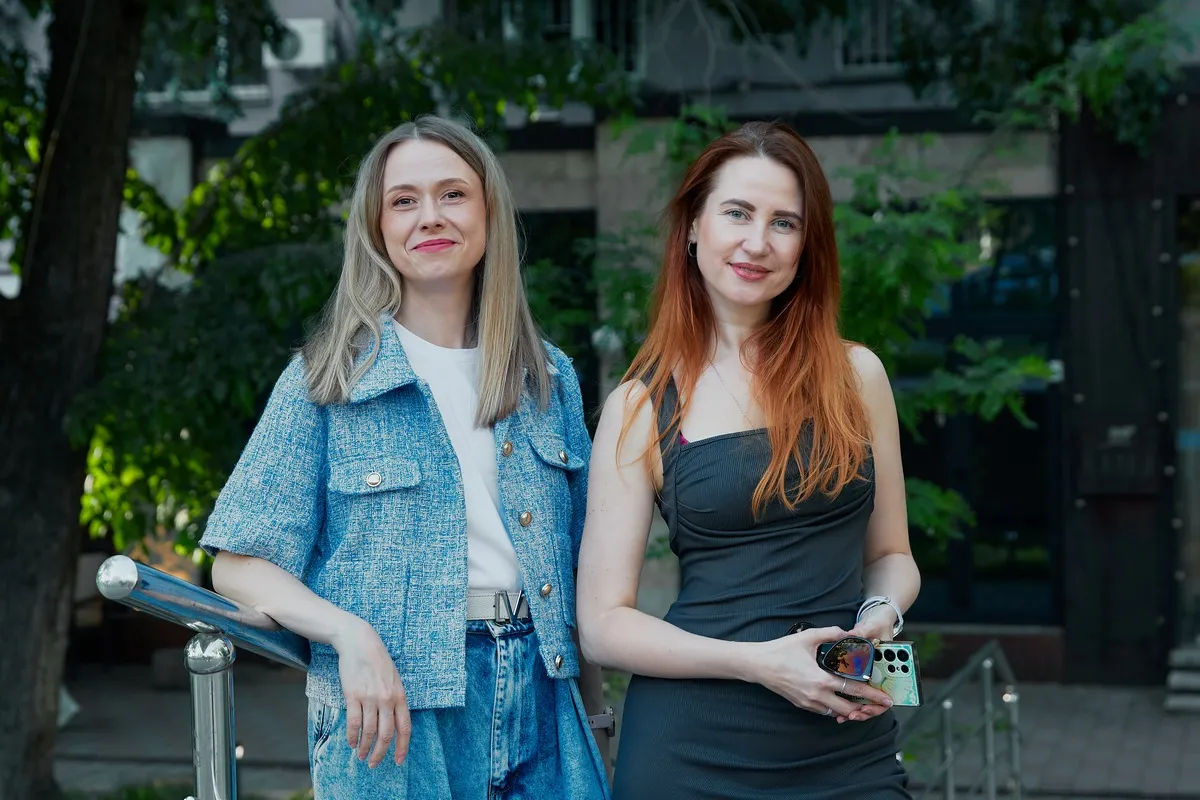
Today, we’re telling the story of Tanya Plotnikova and Natalia Demchenko. For years, they managed marketing at major corporations, then ran their own consulting and research projects. But two years ago, they realized it was time to stop doing everything manually. These processes needed to be automated with artificial intelligence. That’s how gro.now was born, an AI platform for understanding markets and customers.
For the joint project 100 Startup Stories from Central Eurasia, Tanya Plotnikova spoke about the “glass ceilings” inside corporations, why it’s harder for older founders to raise investment at the idea stage, and how AI is making market analytics accessible to businesses of any size.
“You can’t go beyond the shareholders’ strategy when you’re an employee”
– How did you come up with the idea of launching your own startup?
– My degree is in electronic systems and technologies engineering, but while I was still studying, I realized I wanted to be closer to business decision-making and strategy. So I didn’t go into my original field. Instead, I started working in marketing and later earned an Executive MBA.
For nearly 20 years, I worked on developing and promoting tech products. I held marketing roles at telecom corporations in Kazakhstan, the Netherlands, and Russia. These were great companies with well-established processes, significant resources, and ambitious goals.I had plenty of room to grow and prove myself, but at some point, I hit a “glass ceiling.” You can’t really go beyond the shareholders’ strategy. No matter how many ideas you have, you can only implement them within the boundaries of the company’s broader vision.
Several things had to come together at the right moment for us to launch a serious business. One of the key factors was finding the right business partner.I was lucky to meet Natalia Demchenko. We worked together first, and later collaborated on different projects, so I knew I could truly rely on her and that her level of expertise was incredibly high. I have a mix of technical knowledge and an entrepreneurial mindset, while Natasha is an outstanding marketer. Starting gro.now with her didn’t feel scary at all. In many ways, our product reflects her vision and ideas.

– What is gro.now all about?
– Our startup is a tech B2B product connected to marketing. The idea is to give businesses a tool for building long-term relationships with customers by identifying pain points in time, tracking feedback, monitoring competitors, and following market trends.
Most importantly, we want to make research clearer and more accessible for small and medium-sized businesses. Today, artificial intelligence makes that possible.
– At the beginning, your project was called pwron. Why did you decide to rebrand it?
– At first, we registered the company in the US under the name pwron, Inc. and bought the domain pwron.ai. It was a shortened version of “power on,” styled to sound more dynamic. The idea behind the name was simple: switch on the power of AI and gain an advantage.

But it turned out that hardly anyone could pronounce the name correctly. That’s when we realized we needed to change it. We spent a long time brainstorming, but once our CTO suggested the .now domain, the name came together on its own. gro.now sounds like “grow now,” and that perfectly reflects what we’re about. Deep customer understanding is the foundation every company is built and grows on.
“If a marketer adds the coffee shop next door to the monitoring list, they’ll instantly know when competitors launch a new menu”
– How does gro.now work in practice?
– Our ecosystem brings together three modules: business reputation research, customer and employee surveys, and a service for creating referral programs.

– What does reputation research include, and what types of businesses need it?
– For reputation analysis, we take everything from open sources: websites, social media, and map reviews. But the core of the product isn’t just monitoring feedback. It’s about deep analytics of the entire data set, tracking changes over time and comparing insights across different sources.
Every company needs this, but to different degrees. For example, reviews are hugely important for cafes. If the average rating drops, the place immediately loses part of its customer flow. Reputation is also critical for the healthcare sector, because people’s lives and health are involved. But in mining and oil refining, sales are focused on tenders and a few major clients, who don’t really care about online comments.

That’s why we mainly focus on either B2C businesses or B2B companies with a large customer flow.
– Can you give an example of how this works in real life?
– Let me share a real case. A pharmacy chain started seeing a drop in sales. How do you figure out the reason? Maybe the pharmacists had started communicating poorly with customers or being rude. Or maybe the issue was the product range. If a specialist logs into the gro.now platform, they can immediately see the dynamics behind customer reviews and take action. In that particular case, more than 90% of complaints were related to staff qualifications and politeness. By organizing training sessions for employees, the company could significantly reduce the amount of negative feedback. We also recommend collecting feedback directly at the point of sale. An unhappy customer gets the chance to share their experience and “let off steam,” which makes them much less likely to go online and post a negative review later.

On top of that, we regularly send competitor updates by email. For example, if a marketer adds the coffee shop next door to the monitoring list, they’ll immediately find out about a competitor’s new menu or a promotion like “three croissants for the price of two.”
– When should companies run surveys?
– Open sources can sometimes give a distorted picture, because certain consumer groups may be louder than others when talking about their pain points. Building a strategy based only on reviews is the wrong approach. You need to form hypotheses and then test them through target audience surveys.
But surveys come with their own challenge. Every year, it becomes harder to run research using traditional methods. Users have changed: they don’t want to fill out long questionnaires, read questions carefully, or spend time honestly and thoroughly describing their customer experience.

We reduced the survey time from 30 to 40 minutes down to 5 to 7 minutes through gamification and the option to simply record answers by voice. Typing on a phone or computer takes time and isn’t always convenient, so people subconsciously try to shorten their answers just to avoid the hassle. As a result, the responses become less honest and the full picture gets lost. But when customers answer by voice, the feedback becomes much deeper and more valuable.
And the final thing that sets our surveys apart is respondent motivation. After completing a survey, people receive a promo code from a partner, such as a discount on medical services, jewelry, or a fitness club session. This kind of bonus can sometimes increase survey completion rates by 2 to 3 times.
One of our latest updates has been creating a real wow effect among both clients and investors: generating a survey in just 30 seconds.

– Another area you work on is referral programs. What are they all about?
– Probably our most underrated module. What’s the bigger purpose behind any kind of research? To make customers happier and more loyal. And loyalty can and should be monetized by turning customers into brand ambassadors and motivating them to bring in friends. With gro.now, you can set up a referral program in just a couple of minutes without writing a single line of code. All you need to do is define the reward you’re ready to offer and add compelling copy.
Referral programs can also be used for hiring staff, such as cashiers, sales assistants, and cooks. For industries that constantly struggle with staff turnover, attracting new people through recommendations from current employees is a practical solution.
Overall, we see our platform as a single tool for the entire company, one that can also support internal processes. When we start working with a business, we try to meet with as many departments as possible to show how gro.now can be used across different teams.

– What powers the service behind the scenes?
– We use Google’s Gemini as our LLM, fine-tuned on a massive dataset of research materials and real survey responses.The platform is built around an agent-based architecture, where each agent handles its own task: collecting, labeling, analyzing, and validating data. Kazakh is one of Gemini’s officially supported languages, which is why the translation quality is very high.
“Industry events have become one of our main acquisition channels”
– How many clients do you currently have, and what industries are they in?
– We currently have 15 paying clients across construction, healthcare, education, and HoReCa. We also work with a fintech company and an electrical equipment manufacturer. They all pay for an annual subscription.
Among our additional services is access to third-party respondent databases. We also occasionally run full-service research projects, though those are mostly one-off cases that help us better understand which processes should be automated.

Recently, we launched a free plan for very small businesses, and it already has hundreds of users. It doesn’t hurt our economics because the plan comes with strict limits. At the same time, we feel like we’re contributing to the growth of entrepreneurship. And of course, we also expect some of those users to eventually convert into paying customers.

– How do you attract clients?
– We have extensive corporate experience and a strong reputation in the industry, so our first sales came through our network of contacts. Without that foundation, things would have moved much slower. From the very beginning, we started working with large companies and large-scale projects.
Industry events have also become one of our main acquisition channels. For example, after our pitch at the fourth season of Unicorn Arena, we received a huge number of leads from potential clients. That’s why we try to make the most of opportunities like these. We’ve taken part in several Astana Hub programs, including AI’preneurs, Silkway Accelerator, and Hero Training. Recently, gro.now was selected as one of 10 startups representing Kazakhstan in the semifinals of the Supernova Pitch Competition at GITEX 2026. And at the Digital Qazaqstan Battle in Shymkent, organized by Astana Hub, we won the grand prize of 10 million tenge.

We also have a sales team that finds contacts both through personal networks and referrals from existing clients.
So far, we’ve spent very little on advertising. But the number of leads keeps growing thanks to media coverage, social media mentions, and search engine optimization.
– Can you share any cases where gro.now helped a business spot a problem or make a decision?
– One private school wanted to improve its meal program and launched a parent survey through our platform. Thanks to the voice transcription feature, they were able to collect a lot of authentic, detailed, and genuinely insightful feedback that’s already being used to make changes.

Another company ran a large-scale study where respondents were asked to compare the country’s top brands and share how they felt about them. This generated a wealth of insights for further development and positioning adjustments. In this case, thanks to voice responses and gamification, the average survey completion time was 4.5 minutes instead of the usual 25 to 30.
“Sometimes you have to dip into your last personal savings or even borrow money from friends”
– What funding are you using to grow the project?
– Unfortunately, we weren’t able to raise investment at the idea stage. Maybe it was because we didn’t fit the typical startup founder profile. We’re not in our twenties anymore, and we come from a long corporate background. Or maybe we just weren’t pitching convincingly enough.
During the first year, we built the project entirely with our own money, and only in 2025 did we secure angel investment. In total, around $200,000 has gone into the company: $50,000 from an investor and $150,000 of our own funds.
We managed to stretch the angel check over quite a long period. We still have some runway left, and in certain months we even reach operational break-even. But honestly, there are still moments when we have to dip into our last personal savings or even borrow money from friends.

– Are you currently looking for investment?
– We’ve opened a new round, a late pre-seed round, and plan to raise $500,000 by the end of June. We already have stable revenue and have significantly accelerated our sales growth, so we now have real traction to show investors.
– What will you use the money for?
– We’ll allocate 60% to marketing and sales growth, 20% to product and infrastructure stabilization so the platform can handle a larger volume of clients, and the remaining 20% will go toward other operational expenses.
“It’s easier to hire people when there’s a brand worth millions behind your logo”
– How many people are on the gro.now team?
– We currently have 7 full-time team members, but during peak periods we expand to around 15 by bringing in freelancers for specific one-off tasks.
I’m really proud of our team. We managed to find people who are genuinely passionate about what they do. After spending many years in the corporate world, I understand how much easier it is to hire people when there’s a multimillion-dollar brand behind your logo. Convincing people to join a startup in a situation full of uncertainty is a much harder challenge.
– The team is in place and you already have clients. How are you planning to scale?
– Our home market is Kazakhstan and Central Asia as a whole. But that’s only about 1% of the global market in our niche, so we definitely want to expand into other countries as well.

We’re currently exploring Eastern Europe and also planning activities in Canada. We already have a representative there who’s ready to invest in local growth, and we’ve completed initial market research.
Of course, we’re also looking at the US market. The competition there is incredibly intense and the environment is highly demanding, but we believe we can still carve out our own share of the market even there.
When it comes to data monitoring, our physical location doesn’t really matter. On larger markets, we’ll need local representation, but we’re not talking about large offices. One or two people to coordinate operations on the ground will be enough. Most of our growth will come through partnerships.

– Where do you see gro.now in 5 to 10 years?
– We want to change the market research and analytics industry. Our goal is to make sure that even first-time entrepreneurs can access tools that were once available only to large corporations.